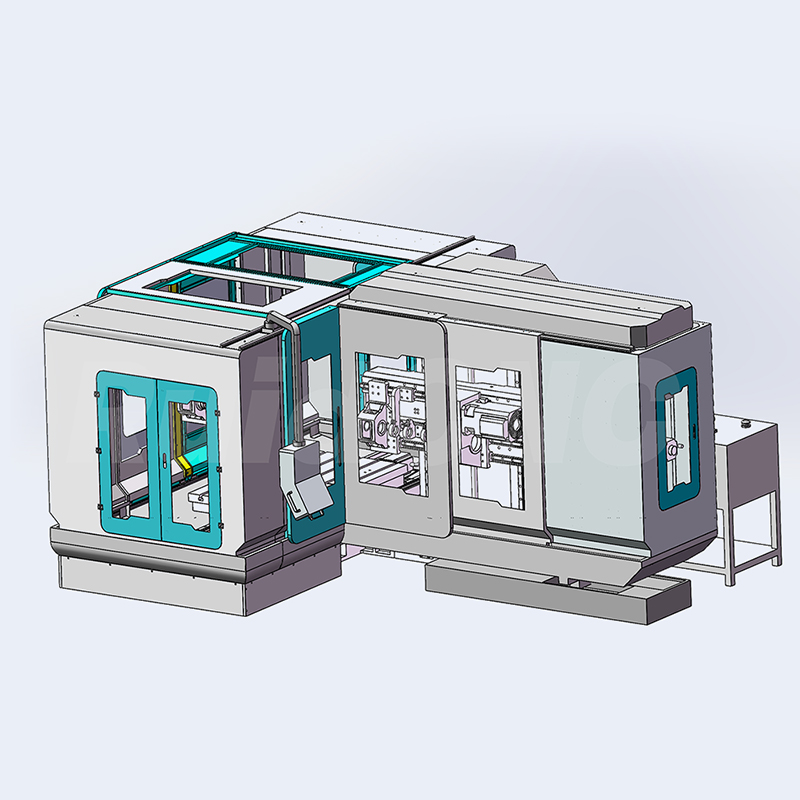
In the field of deep hole machining, traditional tools such as twist drills are no longer effective when faced with small diameters, large depths, and strict accuracy requirements. At this point, machining technology centered around gun drilling machines, with their unique advantages, has become the go-to solution for these challenges. This article will take a long shaft-like workpiece with a hole diameter of Φ40mm and a depth of 2.6 meters as an example, and deeply analyze how to use advanced CNC deep hole drilling machines to achieve perfect alignment between high straightness and high positional accuracy through the “two-ends fighting” process.
1. Principle and Systematic Advantages of Gun Drilling
Gun drilling is not just a single tool but a complete machining system. It uses a unique internal cooling and external chip removal design: high-pressure coolant is forced into the drill rod through an internal channel, directly reaching the cutting area of the drill bit. After cooling and lubricating, the coolant carries chips out through a V-shaped groove between the drill rod and the hole wall.
This principle solves the three core problems in deep hole machining: efficient chip removal, adequate cooling, and stable guidance. The forced chip removal method prevents risks such as tool wear, hole wall scratches, and even drill rod breakage caused by chip clogging. Specialized deep hole drilling machines, like the Ruid CNC RD1612-16H model shown here, provide essential support for the gun drilling process with a stable, ultra-high-pressure cooling system and high-precision CNC feed mechanism, ensuring consistent stability and control throughout the machining process.

2. Core Process Analysis for Ensuring Ultra-High Straightness
For a 2.6-meter long deep hole, the first challenge is controlling the straightness error to a very small range (e.g., 0.1mm/1m). Gun drilling technology excels in this regard:
-
Precision Tool Self-Guidance: The gun drill bit features precisely designed and ground cutting edges and guide bars. During the initial stage of machining, the guide bar forms a stable support ring on the already machined hole wall, akin to “track-guided movement,” which guides the drill bit along the predetermined path, effectively resisting deflection and misalignment.
-
“Two-Ends Fighting” Process Coordination: For ultra-long deep holes, drilling from one end can result in excessive deflection due to the large length-to-diameter ratio, leading to hole misalignment. By employing the “two-ends fighting” process, the total length is divided into two parts, significantly reducing the single processing length-to-diameter ratio, thus improving straightness control.
-
Precision Integration of Equipment and Process: The prerequisite for seamless integration is that the CNC deep hole drilling machine must have extremely high geometric and motion accuracy. Before machining, tools such as precision level meters and micrometers must be used to repeatedly calibrate the alignment of the workpiece axis and the machine tool guide rails in three-dimensional space. During machining, the drill bit enters the hole using precision guide holes pre-machined at both ends and, aided by high-pressure coolant, follows the CNC system’s programmed path, ultimately achieving a “seamless connection” at the center of the workpiece.
3. Key Technology for Achieving “Seamless Connection”: Positional Accuracy Control
The success of the “two-ends fighting” process ultimately hinges on the alignment of the trajectories at both ends when they meet in the center. Any small deviation at the junction can result in steps, misalignment, or even drill bit collisions, leading to serious consequences. This requires extremely high positional accuracy, and the key technologies involved are:
-
Precision Fixtures and One-Time Clamping: The workpiece must be clamped once on the machine tool and positioned using precision V-blocks, center supports, and other fixture components to ensure that the center points of both ends are strictly coaxial. Avoiding the reference errors caused by secondary clamping is the primary principle for ensuring positional accuracy.
-
CNC System’s Precision Coordinate Control: The core advantage of modern CNC deep hole drilling machines lies in their digital precision control. Operators program the exact coordinates for the start points at both ends, and the CNC system, through feedback devices like grating scales, precisely controls the movement of each axis, ensuring that the drill bit’s trajectory at both ends intersects at the theoretical center line.
-
High-Precision Alignment Process: Before drilling officially begins, a strict alignment process is executed. This often involves using high-precision edge finders or optical tool setters to measure and set the center position of both ends of the workpiece, ensuring that the machine tool’s coordinate system aligns perfectly with the theoretical axis of the workpiece.
Conclusion
In conclusion, for deep hole machining with a Φ40mm×2.6m specification, gun drilling machines provide an ideal tool solution, while professional deep hole drilling machines, especially high-precision CNC deep hole drilling machines, offer the platform and accuracy guarantees needed for the process. By ensuring workpiece positioning with precision fixtures, relying on CNC systems for trajectory control, and utilizing the “two-ends fighting” process, a complete technological chain is established that ensures ultra-high straightness and positional accuracy for ultra-long deep holes. This is not just a machining technology but a concentrated reflection of machine tool precision, process philosophy, and operational expertise.